
Tampere Cathedral
Tampere Cathedral is one of the city’s best-known landmarks and a masterpiece of Finnish National Romantic architecture. Designed by Lars Sonck and completed in 1907, it is renowned for its granite exterior and Symbolist art by Hugo Simberg and Magnus Enckell. The cathedral remains an active place of worship and a popular venue for concerts and weddings.

Tuomiokirkonkatu 3, 33100 Tampere
Open daily from 11 am to 3 pm. From 2 May to 31 August, open from 10 am to 5 pm.
040 804 8765
church caretaker
Max 1850 people
Accessibility
- Accessible entrance is on Rautatienkatu. A ramp is available during events and on request.
- Access to the crypt on the lower floor is via a stairlift to the right of the altar. The lift has a seat and cannot accommodate a wheelchair.
- Accessible toilet is located at the back of the church, on the left when viewed from the main entrance. The toilet measures approximately 1.7 × 1.7 metres.
- Ramp to the altar is located on the left side of the altar when viewed from the main entrance.
- Accessible parking is available in on-street parking spaces with a disabled parking permit. Parking is otherwise prohibited on some nearby streets, including Rautatienkatu.
- Hearing loop is available in the church.
- Wheelchair spaces are located in the side aisle.
- Braille hymn book is available from staff.
- Large-print hymn books are available on stands by all entrances.
Architecture and history
Tampere Cathedral represents the National Romantic style, combining Neo-Gothic towers and Art Nouveau ornamentation with monumental natural-stone architecture. Architect Lars Sonck won the design competition for the church in 1899, and the building was constructed between 1902 and 1907. Centrally located, it is one of Tampere’s best-known landmarks. Originally known as St John’s Church, the building received its current name in 1923, when the bishop’s seat was moved to Tampere.
Art in the cathedral
Tampere Cathedral is an exceptional work of art in which architecture and visual art form a unified whole. The artistic design of the interior was created by Hugo Simberg and Magnus Enckell. The cathedral’s best-known works form part of Finland’s cultural history.
The Wounded Angel
The fresco The Wounded Angel is located on the end wall of the south gallery. Two boys carry an angel seated on a stretcher towards an unknown destination. The factory chimneys of Tampere in the background connect the work to the local landscape. It is one of Finland’s best-known and most beloved works of art.
 Hugo Simberg: The Wounded Angel.
The Garden of Death
In The Garden of Death, located beneath the north gallery, death is depicted as a gentle and caring figure tending its plants calmly and attentively.
Simberg’s death is not threatening but human—a part of the cycle of life. The work is one of the cathedral’s most moving and best-known frescoes.
 Hugo Simberg: The Garden of Death, Tampere Cathedral. Photo: Hannu Jukola.
The Resurrection altarpiece
Magnus Enckell’s altarpiece The Resurrection (1907) forms the focal point of the church interior. A procession emerging from the darkness moves towards light and brightness.
The work is both quiet and solemn, Symbolist and ecclesiastical. Enckell’s use of colour and composition creates a focal point around which the entire space is arranged.
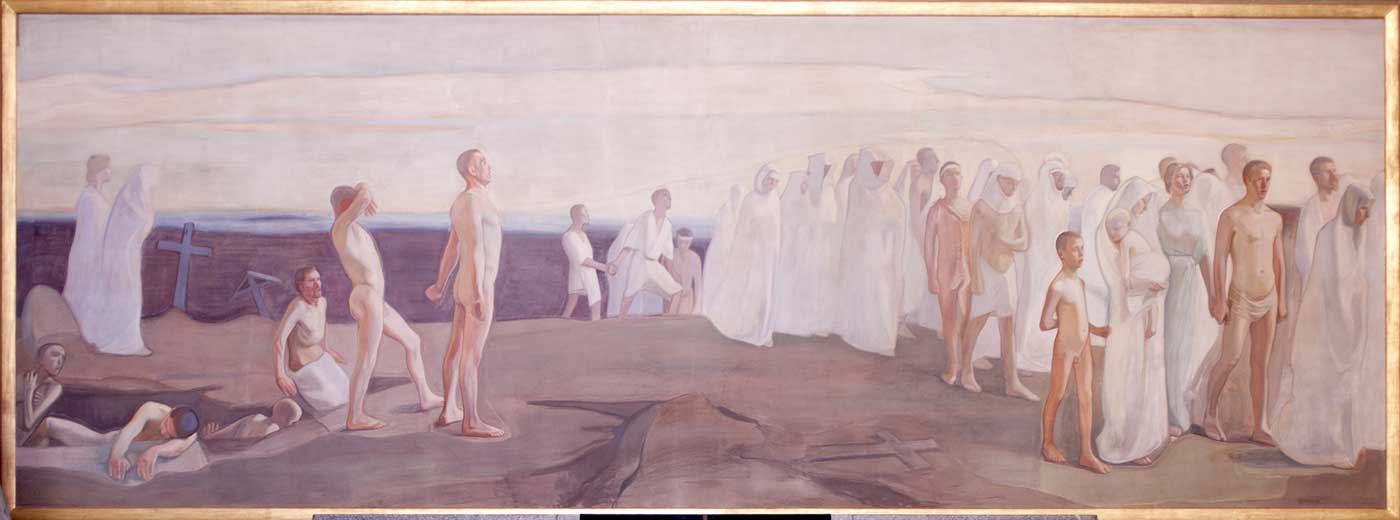 Magnus Enckell: Resurrection, the altarpiece of Tampere Cathedral.
The serpent in the ceiling vault
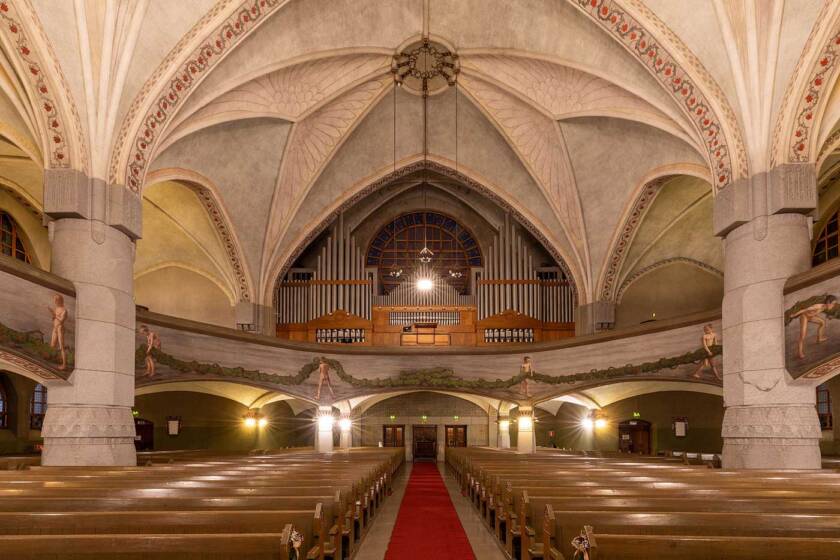
Hugo Simberg painted a serpent with leathery wings at the top of the church’s vaulted ceiling. The wings form a frame around the figure, enclosing it within a guarded circle.
The serpent has traditionally symbolised sin, but Simberg’s interpretation also leaves room for quiet reflection. The work provoked intense debate at the time and remains one of the cathedral’s most discussed details.
 Hugo Simberg’s serpent fresco on the vaulted ceiling of Tampere Cathedral.
Other works of art and details in the cathedral
The Vine of Life
A sharp, thorny vine designed by Simberg runs along the edge of the gallery. It is carried by twelve nude boys, who have been interpreted as symbols of the disciples.
Stained-glass windows
Simberg designed the cathedral’s stained-glass windows in the National Romantic style. At the centre of the rose window is a crown of thorns above a cross. Coloured light filters into the cathedral, changing the atmosphere of the interior according to the time of day.
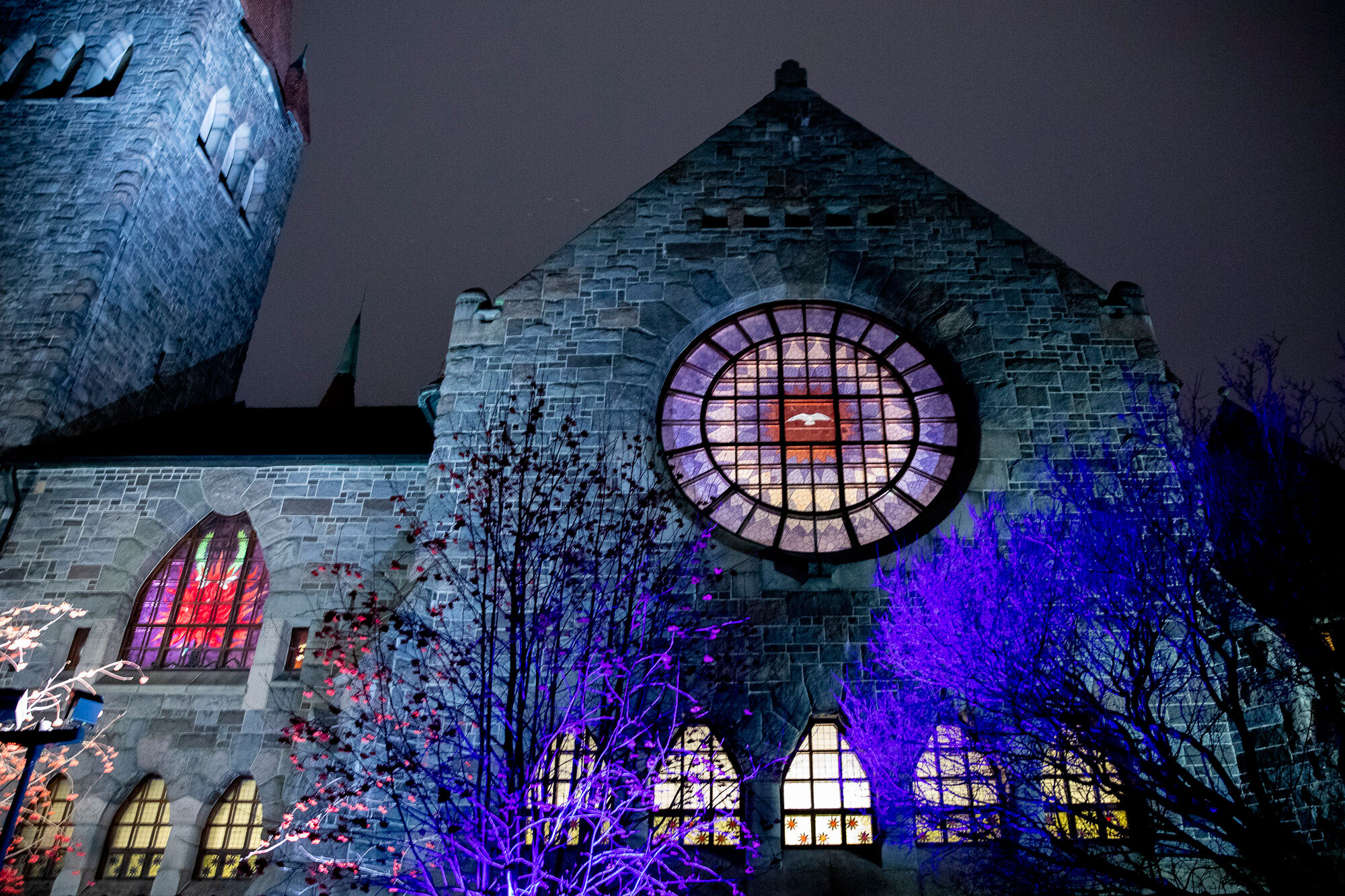 Stained-glass window of Tampere Cathedral.
Pulpit
The pulpit is covered by a thorn-like lattice pattern designed by Simberg, with white wings rising above the stone surface.
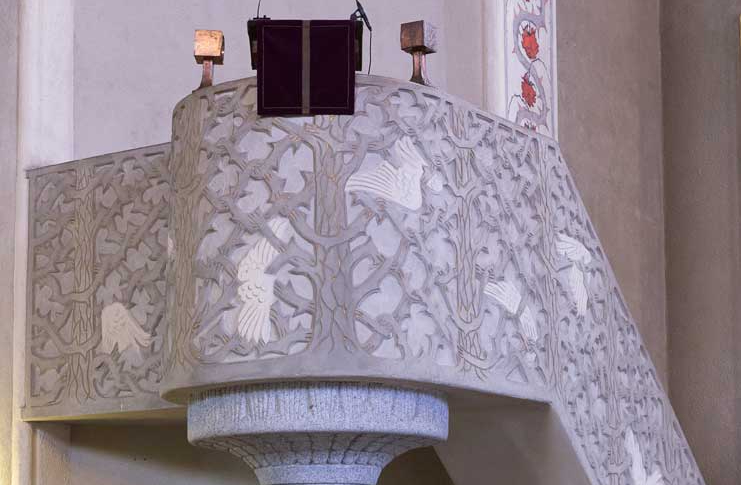 The pulpit of Tampere Cathedral.
Organs
Tampere Cathedral has two organs. The façade of the main organ in the west gallery was designed by Lars Sonck. The instrument has been enlarged and renovated several times during the cathedral’s history.
The Baroque organ in the north gallery was installed in 1981. Both instruments are used in services and concerts.