
Tampere Old Church
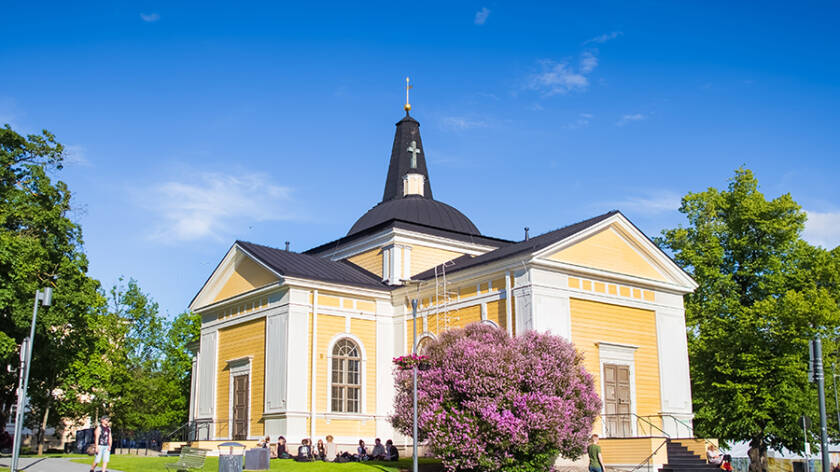
Tampere Old Church is a Neoclassical wooden church on Central Square, completed in 1824 and consecrated in 1825. Together with its historic belfry, it forms an important part of Tampere’s oldest city-centre landscape.
Keskustori, 33100 Tampere
June (9–30): Tue–Fri 12–4 pm
July (1–31): Mon–Fri 12–4 pm
August (3–28): Mon–Fri 1–5 pm
Also open during scheduled activities.
040 804 8766
church caretaker
Max 270 people
Accessibility
- Hearing loop: Available in the worship space.
- Step-free entrance: Via the door on the park side of the church, using a permanent ramp. A wheelchair space is located to the right when entering. Other suitable spaces are also available in the worship space. The church caretaker can provide guidance if needed.
- Accessible toilet: Located on the left-hand side of the worship space when entering through the main entrance.
- Step-free access to the altar: Can be arranged using a portable ramp.
- Large-print hymn books: Available next to the side doors.
A Neoclassical cruciform church
The Old Church is Tampere’s first purpose-built church. Its Neoclassical cruciform design reflects the growth of the city and the need to replace the earlier modest preaching room with a permanent place of worship.
Before the Old Church was built, the people of Tampere worshipped in a preaching room set up in a servants’ building at Tammerkoski Manor. Construction of a new church was delayed by disputes over its location and building material, as well as by the general poverty of the townspeople. Eventually, the authorities granted special permission to build a wooden church, despite opposition from the vicar of Messukylä and his supporters.
By order of the Senate of Finland, Carlo Bassi (1772–1840), head of the Intendant’s Office, prepared plans for a “temporary” wooden church. The construction work was undertaken by merchant Adolf Fredrik Lindberg. Completed in autumn 1824, the church was taken into use with the permission of the Cathedral Chapter before its formal consecration.
Opening and consecration
The first worship service was held in the church on the First Sunday of Advent, 28 November 1824. The church was consecrated on 11 April 1825 and quickly became the main place of worship for the people of Tampere.
Belfry
The belfry is an integral part of the Old Church and the cityscape of Tampere Central Square. Built a few years after the church, it also housed Tampere’s first public clock.
Engel’s belfry and the church bells
The belfry was designed by architect Carl Ludvig Engel (1778–1840), head of the Intendant’s Office. It was built in 1828–1829, with pharmacist Anders Wilhelm Tennberg responsible for the construction contract. The foundations and plinth were built of grey stone, the walls of brick and the roof covered with iron sheeting.
The belfry has two church bells. The larger bell was ordered from Stockholm in 1828. The smaller bell dates from 1999: its predecessor, which had been in use since 1790, cracked on Epiphany in 1998 and is now displayed inside the church.
Tampere’s first public clock
The tower clock in the belfry, with a single hand showing only the hours, was Tampere’s first public timepiece. It was made by Juho Jaakonpoika Ala-Könni (1798–1865), a member of a family of clockmakers from Ilmajoki, and installed in 1835.
Altarpiece and pulpit
The interior combines early church art with later details that contrast with the building’s Neoclassical style. The altarpiece and pulpit are the clearest examples.
Altarpiece: Jesus in Gethsemane
The altarpiece of the Old Church was painted by Robert Wilhelm Ekman (1808–1873). Jesus in Gethsemane was completed in 1831, when Ekman was only 22 years old and studying at the Royal Swedish Academy of Fine Arts in Stockholm. The painting is one of the church’s most significant historic interior features.
Pulpit
The wooden pulpit was designed by architect Carl Aleksander Engel (1818–1843) and built in 1842 by master builder Enok Linderholm. Its elaborate decoration contrasts with the church’s Neoclassical style and makes it a prominent feature of the interior.
Organ
The Old Church has had several generations of organs. The instrument has been rebuilt and replaced over time, while elements of the earliest organ have also been preserved.
History of the organ
The church received an organ built by Anders Thulé (1813–1872) in 1848. The central section of its façade, consisting of non-speaking display pipes, survives from the original instrument. The organ was rebuilt in 1904 by Albanus Jurva and again in 1925 by the Kangasala Organ Factory.
The present fully mechanical organ dates from 1988 and was built by Kangasala Organ Builders. It has two manuals and 21 stops.
Renovations and the church today
The Old Church has changed along with the growth of Tampere. The building has been enlarged, its appearance altered according to the ideals of different periods, and in recent years its facilities have also been developed with greater flexibility and accessibility in mind.
Extensions and 19th-century changes
The church was enlarged in 1847 by extending the chancel arm eastwards. The altar was moved to the site of the original sacristy, and five new rows of pews were added to the chancel. After Alexander Church was completed in 1881, the Old Church initially saw less use, but in the 1890s its interior was remodelled in the Neo-Renaissance style.
Major renovation in the 1950s
In 1953–1954, the church underwent a major renovation according to plans by Nils Erik Wickberg, bringing it closer to its original Neoclassical appearance. The original side galleries were removed, and golden stars were added to the ceiling dome.
Façades, accessibility and changes in the 2020s
The façade renovation of 1995–1996 was designed by architect Hanna Lyytinen, who also designed an accessible entrance for the church in 2011. The interior was altered in 2020–2021: rows of pews were removed from the rear and side arms of the worship space, and some fixed pews were replaced with movable seating. The church now has approximately 240 seats.
A soundproof glass enclosure and adjustable ambient lighting were also added to the worship space. An accessible toilet and café area were built beneath the organ loft, and both the church and belfry were equipped with automatic fire suppression systems. New exterior lighting was installed in 2024.